Q1. Enzymes which catalyse the interconversion of
optical, geometrical or positional isomers are
Ligases
Lyases
Hydrolases
Isomerases
Solution
Isomers are
substances which have the same chemical formula but different optical,
positional or geometric configuration.
Isomerases catalyse
the interconversion of isomeric substances by the rearrangement of molecules.
Q2. When we homogenise any tissue in an acid, the acid-soluble pool represents
Cytoplasm
Cell membrane
Nucleus
Mitochondria
Solution
When we homogenise any tissue in an acid, the acid-soluble pool represents cytoplasm.
It contains the contents of the cytoplasm which include water, carbohydrates, nucleic acids, amino acids and dissolved salts.
Macromolecules and organelles form the acid-insoluble pool.
Q3. Ribozyme is
RNA with enzyme
activity
RNA without sugar
RNA without
phosphate
RNA with extra
phosphate
Solution
Ribozyme is RNA
with enzyme activity.
It catalyses
specific biochemical reactions in a cell.
Q4. The most common monomer of carbohydrates is
Glucose
Fructose
Sucrose
Maltose
Solution
Glucose is the most common monomer of most polysaccharide
carbohydrates.
Starch, glycogen and cellulose are polysaccharides which are formed of
glucose monomers.
Q5. Many elements are found in living organisms either free or in the form of compounds. One of the following is not found in living organisms:
Silicon
Magnesium
Iron
Sodium
Solution
Silicon is absent or found in negligible amounts in living organisms.
Q6. Enzymes are polymers of
Fatty acids
Amino acids
Hexose sugar
Inorganic phosphate
Solution
Enzymes are protein
in nature.
They are polymers
of amino acids which form a three-dimensional tertiary structure.
Q7. An enzyme brings about
Decrease in reaction time
Increase in reaction time
Increase in activation energy
Reduction in activation energy
Solution
Enzymes bring about a reduction in activation energy of a system.
It thus allows a large number of molecules to react simultaneously.
Q8. Which of the following secondary metabolites is wrongly matched?
Pigments - Carotenoids, anthocyanins
Toxin - Abrin, ricin
Polymeric substances - Rubber, gums
Alkaloids - Lemon grass oil
Solution
Lemon grass oil is an essential oil produced as a secondary metabolite in plants.
Alkaloids are secondary metabolites produced by plants which include morphine and codeine.
Q9. The rate of energy metabolism is equivalent to the
Rate of oxygen consumption
Rate of carbon dioxide consumption
Rate of nitrogen consumption
Rate of hydrogen consumption
Solution
Oxidation of carbohydrates, fats and proteins to form CO2 and H2O liberates energy.
These reactions are referred to as energy metabolism.
For oxidation processes, oxygen is required.
Thus, the rate of energy metabolism is equivalent to the rate of oxygen consumption.
Q10. A nucleoside differs from a nucleotide in not having a
Sugar
Glucose
Nitrogen base
Phosphate group
Solution
A nucleoside contains a pentose sugar and a nitrogen base.
When a phosphate molecule is added to a nucleoside, a nucleotide is
obtained.
A nucleotide contains a pentose sugar, a nitrogen base and a phosphate
molecule.
Q11. Which of the following biomolecules are not strictly
macromolecules?
Lipids
Polysaccharides
Proteins
Nucleic acids
Solution
Lipids form a part
of the acid-insoluble fraction but have a molecular weight less than 800
dalton.
Hence, lipids are biomolecules which are not strictly macromolecules.
Q12. Which one contains four pyrimidine bases?
GATCAATGC
GCUAGACAA
UAGCGGUAA
TGCCTAACG
Solution
Adenine and guanine are purine bases.
Thymine, cytosine and uracil are pyrimidine bases.
In option A - GATCAATGC - two thymine molecules and two cytosine molecules are present.
Q13. Enzyme amylase belongs to
Transferases
Hydrolases
Isomerases
Oxidoreductases
Solution
Amylase brings
about hydrolysis of starch and results in the formation of smaller molecules
of carbohydrates - maltose.
Thus, amylase is a hydrolase.
Q14. Which one is correct base pairing for
DNA molecule?
Cytosine-Uracil
Thymine-Guanine
Adenosine-Thymine
Thymine-Uracil
Solution
In a DNA molecule, adenosine pairs with thymine using two hydrogen
bonds.
Q15. Which is wrong about nucleic acids?
DNA is single stranded in some viruses
RNA is double stranded occasionally
Length of one helix is 45A° in B-DNA
One turn of Z-DNA has 12 bases
Solution
Length of one helix or the pitch per turn of helix is 34A°, 25A° in A-DNA and 46A° in Z-model of DNA.
Q16. The number of base pairs present in one turn of DNA is
9
10
11
12
Solution
One turn of DNA double helix is 3.4 nm long.
Each turn contains 10 base pairs.
Thus, the distance between two base pairs in DNA is 0.34 nm.
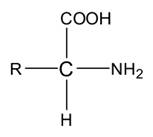
Q17. Amino acids, as the name suggests, have both an amino group and a carboxyl group in their structure. In addition, all naturally occurring amino acids (those which are found in proteins) are called L-amino acids. From this, can you guess from which compound the simplest amino acid is made?
Formic acid
Methane
Phenol
Glycine
Solution
The general structure of an amino acid is given below.
From this we can deduce that the simplest amino acids are derived from methane.
Q18. Nitrogen is an important component of
Lipids
Carbohydrates
Polyphosphates
Proteins
Solution
Proteins are polymers of amino acids.
Nitrogen is an important component of amino acids.
Proteins differ from carbohydrates and fats in having nitrogen as a
component of its structure.
Q19. ATP was discovered by
Karl Lohmann
Lipmann
Bowman
Blackman
Solution
Karl Lohmann
discovered ATP in 1929.
He discovered ATP in muscle
cells.
Q20. Paraffin wax is
Ester
Acid
Monohydric alcohol
Cholesterol
Solution
Paraffin wax is an ester of a long chain fatty acid and alcohol other
than glycerol.
Q21. Which form of RNA has a structure
resembling a clover leaf?
hnRNA
mRNA
tRNA
rRNA
Solution
tRNA has a clover leaf-like structure.
Q22. A peptide bond is formed by the process of
Amination
Dehydration
Rehydration
Deamination
Solution
A peptide bond is formed between the amino and carboxyl groups of consecutive amino acids. The bond is formed by the removal of a water molecule. This process is called dehydration.
Q23. A functional protein is
Enzyme
Collagen
Ossein
Vitamin
Solution
An enzyme functions to regulate metabolism in cells. Enzymes are thus termed functional proteins.
Q24. Among the following natural materials, the
largest amount of cellulose is found in
Wood
Fruit pulp
Wheat straw
Cotton fibre
Solution
Cellulose is most abundant in cotton fibres.
Cellulose makes up to 90% of the composition of cotton fibres.
Q25. The 'repeating unit' of glycogen is
Fructose
Mannose
Glucose
Galactose
Solution
The repeating unit of glycogen is glucose. Glycogen is a branched chain polymer. It consists of about 30,000 glucose units.
Q26. The acid insoluble fraction does not contain
Insulin
DNA
Glycine
Cellulose
Solution
Glycine is an amino acid with a small molecular weight. It is present in the acid-soluble fraction.
Insulin, DNA and cellulose are found in the acid-insoluble fraction.
Q27. Enzymes are basically made of
Nucleic acids
Proteins
Fats
Vitamins
Solution
Enzymes are
proteins in nature. Amino acids join and form the building blocks of all
proteins.
Q28. The enzyme found functional in lysosome is
Acid phosphatase
Basic phosphatase
Oxidoreductase
Lyases
Solution
Lysosomes contain
hydrolytic lyases.
These enzymes are
capable of breaking down almost all biological polymers.
Q29. Biocatalysts were found accidently in yeast extract by
Sumner
Kuhn
Buchner
Pasteur
Solution
Buchner accidentally found that an extract obtained from yeast extract fermented glucose exactly in the same manner as yeast.
Because the extract was obtained from living cells, it was called biocatalyst.
Later, these biocatalysts were termed enzymes.
Q30. The turnover of biomolecules is together called
Catabolism
Metabolism
Anabolism
Bioenergetics
Solution
Biomolecules change to some other form and are also made of some other form of biomolecules. This is called turnover of biomolecules.
Chemical reactions result in making and breaking of biomolecules. These chemical reactions together are termed metabolism.
Q31. Coenzymes FMN and FAD are derived from vitamin
C
B6
B1
B2
Solution
Coenzymes FMN and FAD are composed of flavin, ribitol sugar and
phosphate molecules.
Flavin is derived from riboflavin.
Vitamin B2 is also called riboflavin.
Q32. Chemical reactions require energy for
Oxidation
Entropy
Activation
Enthalpy
Solution
Energy is required for the initiation of any chemical reaction.
This energy activates the molecules of substances taking part in a
chemical reaction.
Q33. Genetic engineering requires enzyme
DNase
Amylase
Lipase
Restriction
endonuclease
Solution
Restriction
endonucleases are known as biological scissors.
They are of
different types. Each restriction endonuclease cuts the DNA at a specific
site only, resulting in the formation of a fragment which can be used for
recombination techniques.
Q34. Enzymes with slightly different molecular structure but performing
identical activity are
Holoenzyme
Isoenzymes
Apoenzymes
Coenzymes
Solution
Enzymes which have minor differences in
their molecular structure but perform identical catalytic activity are called
isoenzymes or isozymes.
Q35. Which one is true for ATP?
ATP is a prosthetic part of an enzyme.
ATP is an enzyme.
ATP is organic ions of enzyme.
ATP is a coenzyme.
Solution
ATP works in conjugation with many enzymes. It transfers the phosphate group to the substrate and releases energy.
Q36. Enzymes increase the rate of biochemical reaction through
Lowering activation energy
Changing equilibrium
Forming enzyme-product complex
Forming reactant-product complex
Solution
Enzymes increase the rate of biochemical reaction through lowering the activation energy.
By lowering the activation energy, it allows a large number of molecules to react at a time, and thus, the rate of chemical reaction increases.
Q37. Nitrogen base + pentose sugar + phosphate group is
Nucleoside
Nucleic acid
Nucleotide
Pyrimidine base
Solution
Nitrogen base + pentose sugar + phosphate group is a nucleotide.
Repeated units of a nucleotide form a DNA strand.
Q38. No cell can live without
Chloroplasts
Proteins
Enzymes
Phytochromes
Solution
Enzymes regulate metabolic processes in a cell. Thus,
a cell cannot live without enzymes.
Q39. Uracil is present in RNA at the place of
Adenine
Guanine
Cytosine
Thymine
Solution
Uracil is a pyrimidine present in RNA in place of
thymine in DNA.


Comments
Post a Comment