Q1. Which of the following is the correct arrangement of corolla in family Papilionoideae?
C1 + (2) - 2
C1 + 2 + (2)
C1 + (2) - (2)
C(5) A(5)
Solution
In family Papilionoideae, the corolla has 5 petals and is polypetalous. Two anterior petals form a keel which encloses the stamens and pistil. Hence, C1 + 2 + (2) is the correct option.
Q2. Colchicine is obtained from which of the following families?
Poaceae
Brassicaceae
Malvaceae
Liliaceae
Solution
Colchicine is extracted from the plant Colchicum autumnale which belongs to family Liliaceae.
Q3. Which plant will lose its economic value if its
fruits are produced by induced parthenocarpy?
Grape
Pomegranate
Banana
Orange
Solution
The edible part of pomegranate is the testa.
It is not formed if fruits are produced by parthenocarpy. However, in fruits
such as grapes, induced parthenocarpy is beneficial
as they contain seeds.
Q4. A fruit developed from the hypanthodium
inflorescence is
Hesperidium
Sorosis
Syconus
Caryopsis
Solution
Syconus fruit develops from hypanthodium
inflorescence. Example: Ficus carcia. In this type of inflorescence, the flask-shaped
receptacle encloses female flowers which give rise to achene-like
fruitlets.
Q5. What type of placentation is seen in
sweet pea?
Marginal
Basal
Axile
Free central
Solution
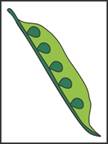
In marginal placentation, the placenta
forms a ridge on the ventral suture of the ovary and the ovules are borne on
this ridge.
Such placentation is seen in pea.
Q6. Vexillary aestivation is characteristic of family
Fabaceae
Asteraceae
Solanaceae
Brassicaceae
Solution
Vexillary aestivation is characteristic of family Fabaceae. In this type of aestivation, the largest (standard) overlaps the two lateral petals (wings) which overlap the two smallest anterior petals (keel).
Q7. If a primary root continues to grow, then
the type of root system will be known as
Secondary
Fibrous
Tap
Stilt
Solution
The tap root system is also known as the
primary root system. The primary root grows vertically downwards, grows laterally
and gives rise to secondary and tertiary roots which help the plant in fixing
itself firmly in the soil.
Q8. The plant which bears clinging roots is
Trapa
Orchid
Screw pine
Podostemon
Solution
Clinging roots are modified adventitious roots meant for providing
mechanical support. Examples: Orchids, ivy
Q9. Another name for multicostate venation
is
Pinnately parallel
Parallel
Palmately reticulate
Reticulate
Solution
Reticulate venation is of two types - pinnately
reticulate venation and palmately reticulate venation.
In palmately reticulate venation, more main veins rise from the base of the
leaf. Hence, it is also called multicostate venation.
Q10. Find the incorrect statement.
Root hair are unicellular elongations.
Root hair absorb water and minerals.
Trichomes are unicellular elongations.
Trichomes are multicellular elongations.
Solution
Trichomes are leaf hair which are derived from one or more epidermal cells present on the leaf surface. Hence, trichomes may be either unicellular or multicellular.
Q11. Flowers in which only one set of
essential organs is present are said to be
Bisexual
Monoecious
Dioecious
Polygamous
Unisexual
Solution
In a unisexual, either an androecium or
a gynoecium is present.
Q12. Roots of which plant contain an oxidising agent?
Carrot
Soyabean
Mustard
Radish
Solution
The roots of soyabean contain leghaemoglobin. Their main function is
to help in the transport of oxygen to the respiring symbiotic bacterial cells
in a manner analogous to haemoglobin which transports oxygen to respiring
tissues in animals.
Q13. Select the incorrect statement with respect to
twiners.
Tendrils and thorns are produced in twiners.
Stems are very sensitive to contact.
Flexible stem twins are produced due to nutritional growth.
None of the above.
Solution
Specialised climbing organs such as
tendrils, thorns, spines and hooks are produced in climbers.
Q14. Name the roots which arise from any other plant
part.
Tap root
Fibrous root
Adventitious root
Fusiform root
Solution
The roots which arise from any other plant
part except radicle are called adventitious roots.
Q15. The thorn of Bougainvillea and the tendril of Cucurbita are examples
of
Vestigial organs
Retrogressive evolution
Analogous organs
Homologous organs
Solution
Homologous organs are the organs which exhibit anatomical similarities
but perform different function.
The thorn of Bougainvillea and the tendril of Cucurbita are
modifications of stem. Both arise from the axillary bud. Thorns provide
protection to plants, while tendrils provide support to the climbing plant.
Q16. Pneumatophores are present in
Xerophytes
Hygrophytes
Mesophytes
Halophytes
Solution
Halophytes are the plants found in areas
of high salinity such as estuaries and marshy regions. These plants are
usually rooted in water logged, anaerobic mud. Many roots come out of ground
and grow vertically upwards to get oxygen for respiration. These roots are
called pneumatophores.
Q17. Trimerous flower, superior ovary and axile placentation are the
characteristics of
Cucurbitaceae
Solanaceae
Compositae
Liliaceae
Solution
Characters of family Liliaceae:
1. Leaves are mostly basal, alternate, linear, and exstipulate with
parallel venation.
2. Inflorescence is solitary/cymose. Flowers are often in umbellate
clusters.
3. Flowers are bisexual, actinomorphic and trimerous.
4. Perianth: There are six (3+3) tepals which are often united into a tube.
Valvate aestivation is observed.
5. Androecium: Stamens are six, 3+3 in number.
6. Gynoecium is tricarpellary and syncarpous. Ovary is superior,
trilocular with many ovules and with axile placentation.
7. Fruits are capsule-shaped and rarely berry.
8. Seed is endospermous.
Q18. Which of the following plants have long slender and coiled stem
tendrils developed from axillary buds?
Grapevine and pumpkins
Australian Acacia and watermelon
Bougainvillea and cucumber
Strawberry and grapevine
Alstonia and pumpkins
Solution
Grapevine and pumpkins
Q19. A simple cluster of radial leaves with exstipulate and parallel venation and cyme or umbel inflorescence are the characteristics of
Poaceae
Liliaceae
Asteraceae
Fabaceae
Solution
Characters of family Liliaceae:
1. Leaves are mostly basal, alternate, linear, and exstipulate with parallel venation.
2. Inflorescence is solitary/cymose. Flowers are often in umbellate clusters.
3. Flowers are bisexual, actinomorphic and trimerous.
4. Perianth: There are six (3+3) tepals which are often united into a tube. Valvate aestivation is observed.
5. Androecium: Stamens are six, 3+3 in number.
6. Gynoecium is tricarpellary and syncarpous. Ovary is superior, trilocular with many ovules and with axile placentation.
7. Fruits are capsule-shaped and rarely berry.
8. Seed is endospermous.
Q20. The roots which penetrate the host tissues are
called
Haustorial roots
Floating roots
Assimilatory roots
Epiphytic roots
Solution
The roots of parasitic plants which
penetrate the host tissues to absorb nourishment are called haustorial roots.
Q21. Find the odd one out.
Tribulus
Tridax
Bassela
Evolvulus
Solution
Tridax is a decumbent trailer which branches
after growing horizontally for some length and then grows vertically upwards.
Q22. Some roots resemble the shape of pillars. In which
plants do we observe these roots?
Maize
Sugarcane
Pandanus
Banyan
Solution
In Banyan, the roots grow vertically
downward, penetrate the soil, become thick and assume the shape of pillars.
Q23. Hypanthodium is
Thalamus
Fruit
Inflorescence
Ovary
Solution
Hypanthodium is a type of inflorescence in
which the axis becomes fleshy and pear-shaped with a hollow cavity inside.
Example: Ficus
Q24. If the position of the ovary is below the sepals, petals, stamens, the flower is called
Epigynous
Perigynous
Misogynous
Metagynous
Solution
In an epigynous type of flower, the ovary is fused and enclosed within the thalamus and the other parts rise above the ovary.
Q25. A flower which can be divided into equal
vertical halves by more than one plane of division is
Actinomorphic
Zygomorphic
Heteromorphic
Cyclic
Solution
Floral symmetry is the shape, size and
arrangement of floral appendages around the axis of a flower. On the basis of
floral symmetry, three conditions are seen in flowers:
1. Actinomorphic: Flowers are with
radial symmetry. A flower can be divided into two equal radial halves in any
radial plane passing through its centre.
Example: Datura
2. Zygomorphic: These flowers can be
divided into halves only in one plane.
Example: Pea
3. Asymmetric: Flowers are cannot be
divided into equal halves in any vertical plane.
Example: Canna
Q26. Select the incorrect statement regarding a fusiform
root.
It is spindle shaped.
Secondary roots arise from the thin apical part of the tap root.
The middle portion of the root is thick which gradually tapers towards
the apex.
Thin secondary roots arise from the apical portion.
Solution
Secondary roots arise from the thin apical part of the tap root. This
is a characteristic of a napiform root.
Q27. The fruit of groundnut is
Legume
Caryopsis
Berry
Nut
Solution
The legume or pod develops from a monocarpellary gynoecium. It is a
dry dehiscent fruit which occurs in Leguminosae plants such as pea, gram,
bean and groundnut.
Q28. Find the correct match:
Mustard plant - Leaves opposite
Mustard plant - Leaves alternate
Guava plant - Leaves alternate
Guava plant - Leaves whorled
Solution
Leaves of mustard plant are alternate, pinnately compound or simple.
Q29. A fibrous root system is excellent for
Food
storage
Nitrogen
fixation
Absorbing
water from deeper layers of soil
Providing
good anchorage for the plant
(i) and (iv) are correct.
(iv) and (ii) are correct.
(i), (iii) and (iv) are correct.
(i), (ii), (iii)
and (iv) are correct.
Solution
The main functions of fibrous roots are
(i) Absorption of water and minerals from
the soil
(ii) Providing a proper anchorage to plant parts
(iii) Storing reserve food material
(iv) Synthesis of plant growth regulators
Q30. The fibrous root system is mostly found
in
Dicot plants
Monocot plants
Pteridophytes
Bryophytes
Solution
In monocots, the primary root is short
lived. It is replaced by a large number of roots which originate from the
base of the stem. These roots constitute the fibrous root system.
Q31. The edible part of mango is
Receptacle
Epicarp
Mesocarp
Endocarp
Solution
The mesocarp in mango is the middle
fleshy edible part.
Q32. Find the odd one out.
Turnip
Radish
Beet
None of the above
Solution
Radish is an example of a fusiform root,
whereas the rest are examples of a napiform root.
Q33. A scar on the seed coat through which the developing seed is attached to the fruit is
Epicotyl
Hilum
Hypocotyl
Coleorhiza
Solution
The seed coat is the outer protective covering of the seed. The hilum is the scar on the seed coat through which seeds are attached to the fruit.
Q34. A horizontal underground stem is a
Corm
Phylloclade
Rhizome
Rhizoid
Solution
Rhizomes are also called root stalks. They are the underground growth
of plants from which the parts which grow above the ground develop. A rhizome
usually grows perpendicular to the direction of the force of gravity, i.e.
they grow horizontal.
Q35. Corm is a modification of
Root
Leaf
Stem
Bud
Solution
A corm is a modified underground stem which acts as a food reserve.
Q36. In monocotyledonous seeds, the endosperm is separated from the embryo by a distinct layer known as
Testa
Aleurone layer
Tegmen
Scutellum
Coleoptile
Solution
The aleurone layer is the outer covering of the endosperm. It is proteinous in nature.
Q37. Vivipary is characteristic of
Mesophytes
Xerophytes
Hygrophytes
Halophytes
Solution
Vivipary is a special type of seed
germination which occurs in halophytes in which seeds germinate inside the
fruit when it is still attached to the parent plant.
Q38. Ginger is an underground stem. It is distinguished from the root
because
It lacks chlorophyll.
It stores food.
It has nodes and internodes.
It has xylem and vessels.
Solution
A root does not have nodes and internodes, while a stem is characterised
by nodes and internodes.
A node is a region on the stem from which leaves develop, while an
internode is the region between two nodes.
Because ginger shows the presence of node and internode, it is a
modified underground stem.
Q39. The fruit of Mangifera indica is
Berry
Drupe
Capsule
Siliqua
Solution
Drupe in mango is the fruit which is one-seeded, simple, fleshy and develops
from a multicarpellary gynoecium.
Q40. A family delimited by the type of inflorescence is
 Such placentation is seen in pea.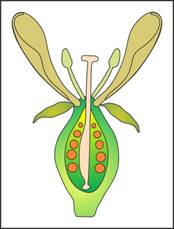
Comments
Post a Comment