Q1. In which of the following would you place the plants with vascular
tissue lacking seeds?
Algae
Bryophytes
Pteridophytes
Gymnosperms
Solution
Pteridophytes are terrestrial, vascular and seedless plants.
Q2. The phylogenetic system of classification is based on
Morphological features
Chemical constituents
Floral characters
Evolutionary relationships
Solution
The phylogenetic classification system is based on evolutionary
relationships, and it is an acceptable method of classification at present.
Q3. Protonema occurs in the life cycle of
Riccia
Funaria
Chlamydomonas
Spirogyra
Solution
Protonema is the juvenile stage of Funaria. It is a branched, green
filamentous structure formed by the germination of spores under favourable
conditions.
Q4. The moss plant has which of the following characteristics?
Gametophyte
Sporophyte
Sometime gametophyte and sometime sporophyte
Predominantly gametophyte with sporophyte attached to it
Solution
Gametophyte is the dominant stage in the moss plant.
Q5. Male cone of Pinus is made of
Anthers
Ligules
Microsporophylls
Megasporophylls
Solution
Microsporophylls contain sporangia in which haploid microspores develop. Microsporophylls in pine are present on male strobili.
Q6. Which ones are non-vascular?
Bryophytes
Pteridophytes
Gymnosperms
Angiosperms
Solution
Bryophytes are
non-vascular plants. They possess conducting strands for the absorption of
water and minerals.
Q7. Sporophyte dependent on gametophyte occurs in which of the following
options?
Algae
Pteridophytes
Fungi
Bryophytes
Solution
In Bryophytes, sporophyte is attached to the gametophyte. Gametophyte
is photosynthetic, and hence, sporophyte gets its nourishment from the
gametophyte.
Q8. The common mode of sexual reproduction in Chlamydomonas is
Isogamous
Anisogamous
Oogamous
Hologamous
Solution
Different species of Chlamydomonas produce different types of gametes.
Sexual reproduction in Chlamydomonas may be hologamy, isogamy, anisogamy and
oogamy, but isogamy is the most simplest and common type and oogamy is the
most advanced type of sexual reproduction.
Q9. In Chlorophyceae, sexual reproduction occurs by
Isogamy and
anisogamy
Isogamy, anisogamy and oogamy
Oogamy only
Anisogamy and
oogamy
Solution
Chlorophyceae are one of the classes of green algae which
show three types of sexual reproduction—isogamy, anisogamy and oogamy.
Q10. Oogamous sexual reproduction involves the fusion of
Motile and non-motile gametes
Similar gametes
Dissimilar motile gametes
Dissimilar non-motile gametes
Solution
Oogamous is the fusion between a small motile male gamete and a large non-motile
female gamete.
Q11. In Chlorophyceae, sexual reproduction occurs by
Isogamy and anisogamy
Isogamy, anisogamy and oogamy
Oogamy only
Anisogamy and oogamy
Solution
In Chlorophyceae, sexual reproduction occurs by isogamy, anisogamy or oogamy.
Isogamy: The gametes are similar in size and shape. These gametes are not classified as male or female. They are noted as ‘+’ and ‘−’ strains.
Anisogamy: It is the fusion between two gametes which are either dissimilar in size or in both size and morphology. It is observed in Chlamydomonas.
Oogamy: Oogamy is a type of anisogamy. The male gamete is smaller in size than the female gamete.
Q12. Consider the following statements with respect to characteristic features of the kingdom.
(A) In Animalia, the mode of nutrition is autotrophic.
(B) In Monera, the nuclear membrane is present.
(C) In Protista, the cell type is prokaryotic.
(D) In Plantae, the cell wall is present.
Of the above statements,
A alone is correct.
B alone is correct.
C alone is correct.
D alone is correct.
A, B and C are correct.
Solution
(A) In Animalia, the mode of nutrition is heterotrophic.
(B) In Monera, the nuclear membrane is absent.
(C) Protists are unicellular eukaryotes.
(D) In Plantae, the cell wall is present.
Q13. Gymnosperms are characterised by
Multiflagellate sperms
Naked seeds
Winged seeds
Seeds inside fruits
Solution
In gymnosperms, seeds are naked and are not embedded in fruits.
Q14. Gemma for vegetative reproduction occurs in which of the following plants?
Funaria
Fern
Marchantia
Riccia
Solution
Gemma are the green buds in Funaria that develop along the axis of the leaves. They help in vegetative reproductive. When gemma detach from the parent plant, they develop into a new Funaria.
Q15. Pinus differs from mango in having
Tree habit
Green leaves
Ovules not enclosed in an ovary
Wood
Solution
Gymnosperms are known as seeded plants
without flowers because their ovules are not covered and lie naked on the
surfaces of specialised leaves arranged into cones.
Q16. In ferns, meiosis occurs when
Spores germinate
Gametes are formed
Spores are formed
Antheridia and archegonia are formed
Solution
In ferns, sexual reproduction takes place
through spores which are borne in sporangia.
Q17. The product of conjugation in Spirogyra or fertilisation
of Chlamydomonas is
Zygospore
Zoospore
Oospore
Carpospore
Solution
In Chlamydomonas, the zygospore is the
resultant of isogamy, anisogamy or oogamy.
In Spirogyra, sexual reproduction occurs
through conjugation which may be scalariform or lateral. The resulting zygote
secretes a thick wall and is called zygospore.
Q18. Bryophytes depend on water because water is required for which of the
following processes?
Vegetative propagation
Filling archegonium for fertilisation
Swimming of sperm up to egg inside
archegonium
Fertilisation of homosporous plants
Solution
Bryophytes require a layer of water on
the soil so that the antherozoids can swim to the archegonium. Once they
reach the archegonium, one of the antherozoids fuses with the egg cell to
form the zygote.
Q19. Sago of Cycas is given to patients with stomach disorders because it is
Cheap
Easily digestible with less starch
Tastier
With high nutritive value
Solution
Sago is a pure starch extract in the liquid state. In the solid state, it is in the form of granules. The sago obtained from Cycas circinalis is easily digestible. It is a major staple food for people from New Guinea.
Q20. Fusion of two gametes which are dissimilar in size is termed
Oogamy
Isogamy
Anisogamy
Zoogamy
Solution
Anisogamy is the fusion between two gametes which are either dissimilar in size or in both size and morphology. It is observed in Chlamydomonas. Oogamy is a type of anisogamy.
Q21. Floridean starch occurs in
Myxophyceae
Chlorophyceae
Rhodophyceae
Phaeophyceae
Solution
In Rhodophyceae (red algae), food is stored in the form of floridean starch. Its grains are stored outside the chloroplast.
Q22. Protonema has which of the following characteristics?
Haploid and found in mosses
Diploid and found in liverworts
Diploid and found in pteridophytes
Haploid and found in pteridophytes
Solution
Protonema is one of the stages of the gametophyte in the life cycle of moss. It develops from a spore. It is green, branched, filamentous and creeping.
Q23. Agar is commercially received from
Green algae
Blue-green algae
Brown algae
Red algae
Solution
Red algae Gelidium and Gracilaria are used for the commercial
production of agar. Agar is used in jellies. It is also used in microbiology
techniques to grow microbes.
Q24. Ribbon-shaped chloroplasts occur in
Chlamydomonas
Spirogyra
Ulothrix
Riccia
Solution
Spirogyra is the name of the genus which is derived from its spiral shaped chloroplasts.
Q25. The gametophytic generation is dominant in which of the following
terms?
Pteridophytes
Gymnosperms
Bryophytes
Angiosperms
Solution
In Bryophytes, the sporophyte is attached to the photosynthetic
gametophyte.
Q26. The nutrient medium is made semi-solid by adding
Pectin
Agar-agar
Sodium chloride
Water
Solution
Agar is the substance obtained from red algae. It is obtained from Gelidium and Gracilaria.
Q27. Resin and turpentine are products of
Teak
Oak
Eucalyptus
Pine
Solution
Turpentine is obtained from pine resin.
Q28. Find the odd one out with respect to haplontic life cycle.
Ectocarpus
Ulothrix
Spirogyra
Chlamydomonas
Solution
In the haplontic life cycle, the plant
body is gametophyte and independent. The sporophyte is not free-living and is
dependent on the gametophyte. It is observed in majority of green algae such
as Ulothrix, Spirogyra and
Chlamydomonas.
Q29. Which of the following is called amphibians of the plant kingdom?
Bryophytes
Pteridophytes
Gymnosperms
Algae
Solution
Though bryophytes grow on damp soil, rocks, walls, on the banks of
ponds, on the bark of trees, they require a layer of water on the surface of
soil for the following reasons:
Movement of male gametes to reach archegonia
For the dehiscence of antheridia
Because they lack conducting tissues, they
require free water for absorption
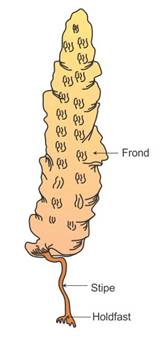
Q30. Holdfast, stipe and frond constitute the plant body in case of
Rhodophyceae
Chlorophyceae
Phaeophyceae
All of the above
Solution
In Phaeophyceae, the plant body is attached to the substratum by holdfast. The stalk is known as stipe. The frond is a leaf-like photosynthetic organ.
Q31. In Pinus, if the pollen grain has 6 chromosomes,
then its endosperm will have
12 chromosomes
18 chromosomes
6 chromosomes
24 chromosomes
Solution
In gymnosperms such as Pinus, both pollen grains and endosperm are
haploid and are formed before fertilisation. If the pollen grain has haploid
number of chromosomes equal to 6, then its endosperm will also have 6
chromosomes.
Q32. Mosses and ferns are found in moist and shady places because both have which of the following requirements?
Require the presence of water for fertilisation
Do not need sunlight for photosynthesis
Depend for their nutrition on microorganisms which can survive only at low temperature
Cannot compete with sun-loving plants
Solution
Mosses lack vascular tissues. Also both mosses and ferns require water to carry out sexual reproduction.
Q33. The dominant photosynthetic phase in the life cycle of Pteridophyta is
equivalent to the
Gametophytic phase of Bryophyta
Sporophytic phase of Bryophyta
Gametophytic phase of Pteridophyta
Gametophytic phase of Gymnospermae
Solution
The dominant photosynthetic phase in the
life cycle of Pteridophyta is equivalent to the gametophytic phase in the
life cycle of Bryophyta.
Q34. The life cycle of cord moss is
Haplontic
Haplodiplontic
Diplontic
Haplohaplontic
Solution
The diplohaplontic or haplodiplontic phase of the life cycle is
characterised by the presence of both sporophyte and gametophyte. Both of
these phases are photosynthetic, multi-celled bodies and often free-living
with almost equal phases - the diplophase and haplophase. All pteridophytes,
bryophytes, cord moss and some brown algae have diplohaplontic life cycles.
Q35. Meiosis occurs in Funaria in
which of the following cells?
Archegonial cells
Spore mother cells
Zygotic cells
Antheridial cells
Solution
In funaria, antherozoids swim towards the archegonium. One of the
antherozoids fuses with the archegonium to form the zygote. With the
formation of zygote, the sporophytic phase begins, during which the zygote
undergoes meiosis to form sporogonium.
Q36. Ulothrix filaments produce
Isogametes
Anisogametes
Heterogametes
Basidiospores
Solution
Ulothrix is a green alga which reproduces
sexually by the union of isogametes which are motile, biflagellate and morphologically
similar gametes. Approximately 8-32 isogametes are produced from a mother
cell.
Q37. Both chlorophyll a and b are present in
Rhodophyceae
Phaeophyceae
Chlorophyceae
None of the above
Solution
Chlorophyceae are green algae. They show the dominance of chlorophyll a and b which are found in definite chloroplasts.
Q38. The plant body is the thallus in
Gymnospermae
Algae
Bryophyta
Pteridophyta
Solution
The thallus is an undifferentiated mass of cells. In algae, the plant
body consists of numerous undifferentiated cells (tissue-level organisation
is absent).
Q39. An incorrect character of brown algae is
Presence of chlorophyll a and b
It remains attached to the substratum
Presence of chlorophyll a and c
Presence of fucoxanthin
Solution
Brown algae possess chlorophyll a but not chlorophyll b. The pigments present in brown algae are chlorophyll a and c, carotenoids and xanthophylls.
Q40. Pyrenoids are characteristically found in the chloroplasts of
Comments
Post a Comment