Translocation of
food due to turgor pressure gradient and imbibition force
Translocation of
food due to turgor pressure gradient
Translocation of
food due to imbibition force
Translocation of
organic solutes
Solution
Munch hypothesis is
a mass flow or pressure flow hypothesis in which the organic substances move from
the region of high osmotic pressure to the region of low osmotic pressure in
a mass flow due to the development of a gradient of turgor pressure.
Q2. In the senescence stage of a
plant, the rate of transpiration is
High
Low
Unchanged
Zero
Solution
The rate of transpiration reduces
in the senescence stage.
Q3. Munch hypothesis is based on
Translocation of food due to turgor pressure gradient and imbibition
force
Translocation of food due to turgor pressure gradient
Translocation of food due to imbibition force
None of the above
Solution
The movement of sugars in the phloem begins at the source where sugars
are loaded (actively transported) into a sieve tube. Movement occurs by bulk
flow (mass flow); phloem sap moves from sugar sources to sugar
sinks by turgor pressure, also known as hydrostatic pressure.
Q4. Which of the following is
impermeable?
Cell wall
Plasma membrane
Cuticle
Cellophane
Solution
The cuticle is impermeable,
cellophane and the plasma membrane are semi-permeable, and the cell wall is
permeable.
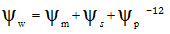
Q5. Cell A has an osmotic potential of −18 bars and a pressure potential of 8 bars, whereas cell B has an osmotic potential of −14 bars and a pressure potential of 2 bars. The direction of flow of water will be
From cell B to cell A
From cell A to cell B
No flow of
water
In both the directions
Solution
In cell A,
In cell B,
So, water moves from a higher concentration to a lower concentration, i.e. from cell A to cell B.
Q6. The root system in a plant is well
developed
Due to deficiency of auxins
Due to deficiency of cytokinins
Due to deficiency of minerals
For increased absorption of water
Solution
Water in land plants is mainly absorbed through the roots, especially
at the tips in the region of root hair. Therefore, the root system in a plant
is well developed for increasing absorption of water.
Q7. The most widely accepted theory
for the mechanism of phloem translocation is
Mass flow hypothesis
Diffusion hypothesis
Electro-osmotic theory
Interfacial flow hypothesis
Solution
The most widely accepted theory
for mechanism of phloem translocation is Munch’s mass flow hypothesis.
Q8. Lenticels are found in
Young leaves
Fruits
Flowers
Yellow leaves
Solution
Lenticels are found in fruits and
woody cells and help in transpiration and gaseous exchange.
Q9. Passive absorption of water by the root system is the result of
Forces created in the cells of the root
Increased respiratory activity in root cells
Tension on the cell sap due to transpiration
Osmotic force in the shoot system
Solution
Passive absorption occurs when the rate of transpiration is usually high. It occurs due to the tension created on the xylem by transpirational pull.
Q10. The rate of transpiration will be less
in a situation where
Groundwater is sufficiently available.
Wind is blowing.
Environment is hot and dry.
Relative humidity is high.
Solution
The rate of transpiration is inversely proportional to relative
humidity which means that the rate of transpiration is lower when the
relative humidity is higher and vice
versa.
Q11. A cell when dipped in 0.5 M sucrose solution has no effect, but when the same cell is dipped in 0.5 M NaCl solution, the cell will
Increase in size
Decrease in size
Will be turgid
Will be plasmolysed
Solution
A hypertonic solution such as sucrose causes exosmosis or withdrawal of water from the cytoplasm. The pressure on the wall is simultaneously reduced and the elastic wall contracts causing a reduction in cell size which is called plasmolysis.
Q12. The form of sugar transported through the phloem is
Glucose
Fructose
Sucrose
Ribose
Solution
Sucrose, which is formed
by the plant during photosynthesis, is a sugar transported through the phloem
of the plant.
Q13. When a cell is plasmolysed, it becomes
Flaccid and its TP becomes 0
Turgid and its TP becomes 0
Turgid and its TP becomes equal to OP
Flaccid and its DPD becomes 0
Solution
In plasmolysis, the pressure potential or the turgor pressure (TP) is zero, and the osmotic concentration of the cell interior is equal to that of the external solution, making the cell flaccid.
Q14. Which one is an incorrect statement?
Movement of water is expressed in terms of free energy.
Free energy determines the direction by which physical and chemical changes should occur.
Water potential is the sum of free energy of water molecules in pure water and in any other system.
Water potential of pure water is zero.
Solution
The free energy of water is the movement of water molecules in a system.
The movement of water molecules determines the free energy, which in turn signifies the physical and chemical changes.
The water potential of pure water at normal temperature and pressure is zero.
The water potential is the total of solute potential, matric potential and pressure potential of pure water.
Q15. Water is released as droplets. This is known as
Root pressure
Transpiration
Guttation
Bleeding
Solution
The loss or excretion of water in the form of liquid droplets from the leaves and other parts of an uninjured plant is called guttation.
Q16. The rate of transpiration of a plant
would gradually increase if
Relative humidity increases
Relative humidity decreases
Relative humidity remains unchanged
Water potential gradient remains unchanged
Solution
The rate of transpiration is inversely
proportional to relative humidity which means that the rate of transpiration
is higher when the relative humidity is lower and vice versa.
Q17. Which one of the following will not
directly affect transpiration?
Temperature
Light
Wind speed
Chlorophyll content of leaves
Solution
Chlorophyll content of leaves does not
affect transpiration as it helps the plants during photosynthesis which is
much required for transpiration.
Q18. Which of the following is not true
about osmosis?
It occurs through a selectively permeable
membrane.
It occurs in liquids and gases.
It is a special type of diffusion.
Only the solvent molecules move
from a region of low concentration to high concentration.
Solution
Osmosis does not occur in any
other medium except liquids.
Q19. Greater the concentration of the
solute particles,
Greater the value of osmotic
potential on the negative side
Greater the value of osmotic
potential on the positive side
Closer the value of osmotic
potential towards zero on the negative side
Closer the value of osmotic
potential towards zero on the positive side
Solution
Greater the concentration of the
solute particles, greater the value of osmotic potential on the negative
side.
Q20. The process of penetration of ions of
living cells from the surrounding through a selective membrane is called
Absorption
Endosmosis
Diffusion
Active transport
Solution
During absorption, the ions or molecules penetrate the inner space of
the living cells or tissues from the surrounding medium through a selective
membrane. The movement of dissolved substances into and out of cells is also
called transport or flux.
Q21. The hydathode helps in
Transpiration
Guttation
Photosynthesis
Respiration
Solution
Hydathodes are usually found on the margins and tips of leaves. So,
the excretion of water is due to the development of a positive pressure in
the xylem present in the vein ending. The pressure forces the liquid out
through the hydathode which is called guttation.
Q22. Which of the following is a
hydrophilic substance?
Wax
Methane
Silica
Grease
Solution
Silica is a hydrophilic substance,
while the rest are hydrophobic in nature.
Q23. Water
reaches the top of a plant due to
Root
pressure
Capillarity
Transpiration
Diffusion
Solution
Water reaches the top of a
tree through capillary action due to the ascent of sap. This can be explained
by the theory of root pressure which develops in the treachery elements of
xylem due to the metabolic activities of roots. This pressure of water is
known as root pressure which is responsible to raise water up to a certain
height.
Q24. Main function of lenticels is
Transpiration
Guttation
Gaseous exchange
Bleeding
Solution
The primary function of lenticels is gaseous exchange. Transpiration
takes place mostly through stomata. Guttation and
bleeding occur through hydathodes.
Q25. Which of the following statements are true/false?
a. The positive hydrostatic pressure is called turgor
pressure.
b. Wall pressure is exerted to prevent the increase of protoplasm size.
c. Diffusion is more rapid in liquids than in gases.
d. Diffusion of water through a semi-permeable
membrane is called imbibition.
e. Osmosis is the movement of substances which occurs along a diffusion gradient.
a and b are true, and c, d and e are false.
a and c are true, and b, d and e are false.
a and d are true, and b, c and e are false.
a and e are true, and b, c and d are false.
c, d and e are true, and a and b are false.
Solution
a. Turgor pressure is the water pressure of the cell vacuole pushing against the cell wall.
b. As turgor pressure exerts its impact on to the cell wall, the cell wall, being plastic, exerts a counter pressure which is called wall pressure which prevents an increase of protoplasm size.
c. Diffusion depends on the number of particles per unit volume, density of medium, temperature and pressure. Therefore, gases diffuse more rapidly than liquids.
d. The absorption or adsorption of water by certain colloids, as in seeds, with resultant swelling of the tissues is called imbibition.
e. Osmosis is a type of diffusion of water which occurs through a semi-permeable membrane.
Q26. The rate at which solutes move in translocation
is about
100 m/hr
200 m/hr
100 cm/hr
200 cm/hr
Solution
The rate at which solutes move in translocation
is about 100 cm/hr.
Q27. Which of the following statements are true?
(A) The apoplastic movement of water occurs exclusively through the cell wall without crossing any membranes.
(B) Solutes present in a cell (or in any solution) increase the free energy of water or water potential.
(C) The symplastic movement occurs from cell to cell through the plasmodesmata.
(D) Membrane permeability depends on membrane composition and the chemical nature of the solute.
A and B only
B and D only
A, C and D only
A, B and D only
Solution
Adding solutes can only decrease water’s free energy because water molecules interact with solute molecules and cannot diffuse easily.
Q28. Cohesion and adhesion theory is otherwise called
Relay pump theory
Pulsation theory
Root pressure theory
Transpiration pull theory
Solution
The upward movement of water is mainly due to the creation of a negative force or tension attributed to the continuous evaporation of water at the surfaces of leaves in the process of transpiration. As molecule after molecule of water evaporates through the stomata, it creates a pulling action on the next molecule of water in the transpiration stream. This pulling force, otherwise called transpiration pull, is strong enough to overcome the force of gravity which is responsible for the tendency of water to move downward.
Q29. Water in
the soil available to plants is
Gravitational
water
Capillary
water
Hygroscopic
water
None
of the above
Solution
The
water present in narrow soil spaces is called capillary water, which is
available to plant roots for absorption.
Q30. Water potential is expressed in
Newton
N/m2
Pascal
Pascal2
Solution
The water potential is expressed
in Pascal.
Q31. Which one of the following theories for ascent of sap was proposed by the eminent Indian scientist J. C. Bose?
Pulsation theory
Relay pump theory
Transpiration pull theory
Root pressure theory
Solution
The theory of ascent of sap was put forward by J. C. Bose in 1923 which is called the vital force theory or pulsation theory. The theory says that the innermost cortical cells of the root absorb water from the outer side and pump the same into xylem channels.
Q32. Which form of carbon was used in
isotopic studies to determine the role of phloem in the transport of food
through the plant?
12C2
13C2
14C2
15C2
Solution
14C2 is a radioactive
form of carbon which was used in isotopic studies to determine the role of
phloem in the transport of photosynthetic products through the plant.
Q33. In a girdled plant, which part
dies first?
Leaves
Stem
Roots
Phloem
Solution
In a girdled plant, the roots die
first. This is because the xylem of the plant transports water and minerals
from the soil to the upper part of the plant. However, because of the absence
of phloem, there is no transport of food to the lower part of the plant,
resulting in its death.
Q34. The cell wall of a root hair has
two distinct layers, of this, the inner layer is made of
Pectin
Cellulose
Chitin
Lipids
Solution
The cell wall of a root hair has
two distinct layers, of this, the inner layer is made of cellulose and the
outer layer is made of pectic substances.
Q35. Which of the following statements does not apply to reverse osmosis?
It is used for water purification.
In this technique, pressure greater than osmotic pressure is applied to the system.
It is a passive process.
It is an active process.
Solution
Reverse osmosis is the expulsion of pure water from a solution through a semipermeable membrane with a higher osmotic pressure. It is used for the purification of water, and it is an active process which requires energy.
A passive process is any process which occurs without an input of energy. Diffusion is the process of a substance moving from an area of high concentration to an area of low concentration in order to obtain equilibrium.
Q36. The cells of the cortex of the
xylem tissue are connected by means of
Casparian strips
Plasmodesmata
Antiporter channels
Symporter channels
Solution
The cells of the cortex of the
xylem are living cells and the cell walls of these cells are connected to
each other by means of plasmodesmata.
Q37. The main significance of facilitated diffusion is
Absorption of mineral ions by plant roots
Excretion of urea and hydrogen ions by mammalian kidneys
Absorption of fructose and nucleotides in the small intestine
Absorption of amino acids from the gut
Solution
Facilitated diffusion helps in the transportation of glucose in liver cells and also helps in the absorption of fructose and nucleotides in the small intestine.
Q38. During the process of respiration,
the movement of CO2 and O2 out and inside the cell is
achieved by
Active transport
Facilitated diffusion
Independent diffusion
Both active and facilitated
diffusion
Solution
The inside and outside movement of
CO2 and O2 during respiration and photosynthesis is
achieved by independent diffusion.
Q39. Which of the following is not a purpose
of transpiration?
Helps in absorption and transport in plants
Prevents loss of water
Maintains shape and structure of plants by keeping the cell turgid
Supplies water for photosynthesis
Cools leaf surfaces
Solution
Transpiration is necessary for
(i) Transporting minerals from the soil to the plant parts
(ii) Cooling the plant
(iii) Moving sugars and plant chemicals
(iv) Maintaining turgor pressure by keeping the cell turgid
Transpiration is eventually the loss of
water in the vapour form from the exposed parts of the plant which cannot be
prevented.
Q40. The rate of diffusion will be less
in
Concentrated solution
Dilute solution
Neutral solution
Rate of diffusion is not affected
by the concentration of solution
 In cell B,
 So, water moves from a higher concentration to a lower concentration, i.e. from cell A to cell B.
Comments
Post a Comment